

what are they watching? is an interview series for my newsletter in which I chat with a television creative about television itself. Previous interviews include Toheeb Jimoh, Janicza Bravo, Chelsea Peretti, and Jeff Hiller.
This time around, I had the pleasure of speaking with Christopher Gomez, who has worked in television sound on some of my fav shows like Say Nothing, Only Murders in the Building, and Better Things. Most recently, he was Beef’s supervising sound editor, and I was super curious about not just what that process looks like but how he made anger into a sonic experience for the show.
I like to start off by asking what you’re watching lately that isn’t work-related?
This is always the million dollar question I get from friends! Recently, I’ve been trying to catch up on the last season of Wonder Man. I like to find things that’ll let me decompress at the end of the day. I am a Marvel apologist, I grew up a superhero fan, so it’s fun for me to just watch those and dive back into that break from reality. Also, whatever my wife is watching, I kind of pop in. Lately that has been some of our fallback shows…I think we started rewatching Schitt’s Creek for probably the millionth time.
How did you get into working with sound and dialogue?
I took a long-winded road to get here so I’ll give you the TLDR. I used to work at the railroad for about seven and a half years, my father-in-law worked there. It was a safe failproof job that would always be there for me. After some time I was just kind of like, I don’t know if this is for me, so I decided to go back to school. I really wanted to work in music; sound in movies and television was something I didn’t even know existed. About two years into the program we had post-production sound classes and I was like, What is this? What do you mean I put sounds to picture? I instantly fell in love with it.
We had a course where we had to re-dub an entire scene ourselves, add all the sound effects. I was so mesmerized by the artistic freedom that you get with doing it. There are so many people that work in sound that have these backgrounds in music, I feel like they work very hand in hand, because so much of what we do in sound is very musical, not only in the literal sense that we work with music, but you can treat it almost like musical instruments, everything from the dialogue to the sound effects to the Foley. So it was an easy transition for me, creatively.
When you’re fully immersed in a project, what does a day in the life of a supervising sound editor look like?
Lots of emails and phone calls, which is the unsexy part of it. [Laughs]. Day-to-day operations for me really vary. From the beginning, I’ll get a cut of the project and dive into it with our showrunner, the creatives, picture editors—we go over everything we want to do sonically. Like, what’s the sonic vision? How do we enhance these ideas? Can we make this punch a little bit bigger? Can we make this room feel like there are a lot more people present? Things like that and the overall shape of what we want a project to look like sonically. I take all the information and translate it for a core group of sound editors (dialogue editor, sound effects editor, a Foley team).
What were the conversations around the shape of the sound and the philosophy of Beef’s second season and how did you interpret that in your work?
Being an anthology series, we can’t really go back to the elements that we’ve established. In a continuing show, you’ve established locations and you know what these locations are going to sound like. With Beef, our showrunner Sonny (Lee Sung Jin) pushed us to really think outside the box and not just rely on what we did with season one. The big discussions were around how season two feels a lot more polished in the locations. We’re in the country club, in these really exclusive places, how do we convey that sonically? How do we dial things back, instead of just bombard the audience with just sounds of a bunch of stuff happening? Season two is much more of a slow burn than season one was, how do we do that sonically?
A lot of it was figuring out very methodical placement of sounds to let the audience sink into these performances. It’s just this constant balancing act between what we’re going to build sonically and then letting the music take those moments and back and forth, or letting dialogue take those moments.
Did you run into any sound-related obstacles in Beef’s second season and how did you tackle it?
The drama aspect of Beef is there and easy to grasp onto. I think the hardest part sonically has been to really nail those comedy beats. Sonny has this amazing ability to interject humour into the show. The show can be tense, there’s a lot of anger behind it, but you have to have those moments of relief through it to keep the audience engaged. The bullseye of when to land these comedic moments is so small because you could get it so wrong.
You look at the scene with Carey in the airplane and she has the Shirley Temple and she wipes the toilet seat. It was very easy to take that too far. There were moments during the mix we pushed it a little bit too in the gross, just a little too squishy. It was this great comedic beat of, you’re in this moment with her, and it’s so absurd, you know. But how do we dial back? Carey was phenomenal, she came in and recorded noises and grunts while she was wiping the toilet bowl. So how much of that do we pepper in? Those little moments are always such a unique sonic challenge. How do we land those moments without taking it too far, but also just enough?
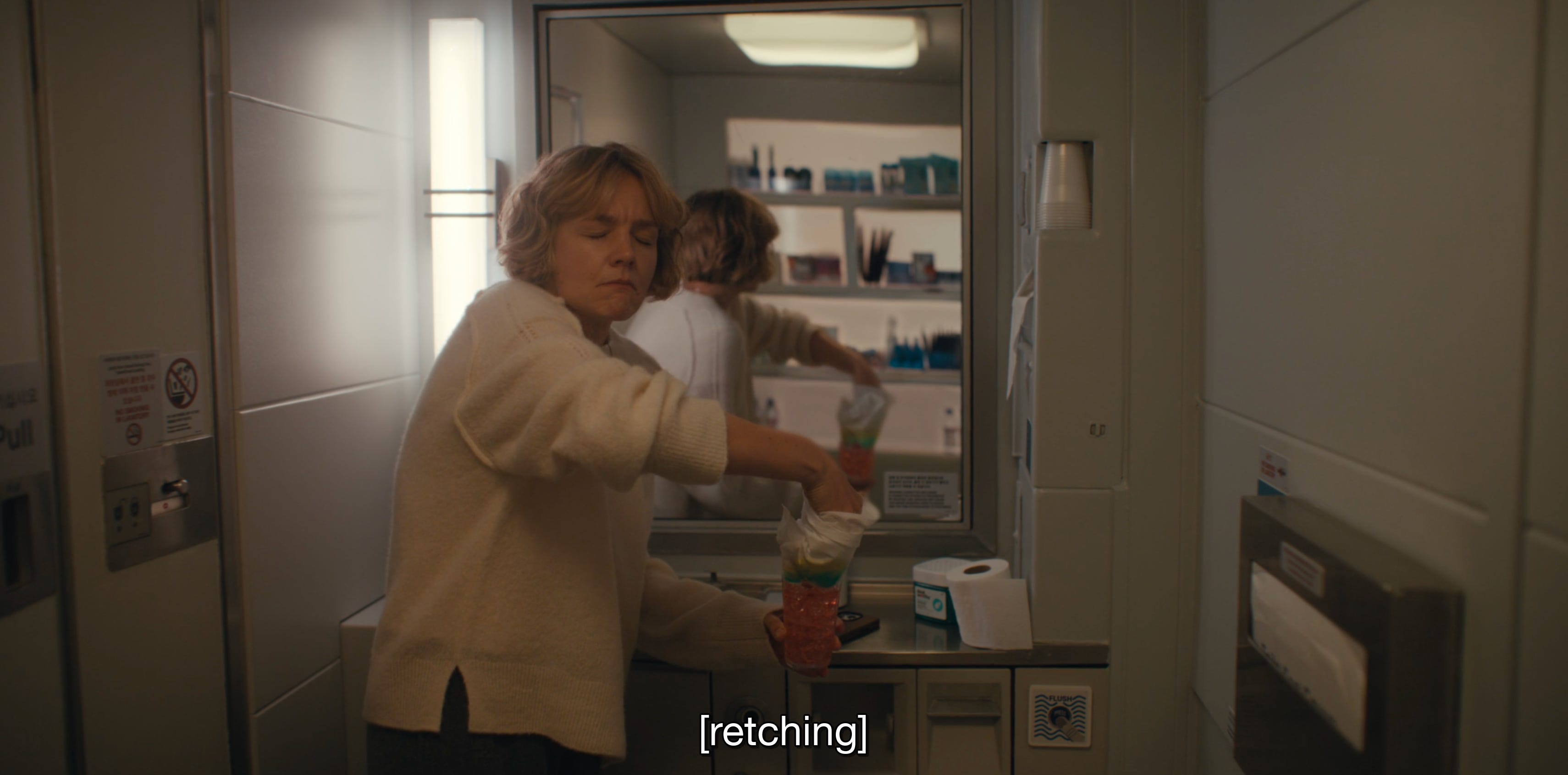
That scene was making me gag. Even more than the orange juice for some reason! We all know how nasty those airplane toilets are.
For me it was more visceral. The orange juice is visceral in its own sense but you could feel Ashley is the anchor of it, like her anger was percolating and it just exploded. It’s just the way Lindsay did it, like this is so fucked up that this is what somebody would do, you know.
Are you someone who has pet peeves about sound or ADR in other things you watch?
I’m probably the least critical person of other people’s sound jobs, mainly because I know the behind the scenes of the creative decisions that lead up to that. People might be like, Oh my god, that line of ADR is so obvious. It’s like, yes, but there were a million reasons as to why that ended up that way. I love the process of filmmaking and I love the amount of work that everybody puts into it. And I know that not everything is necessarily a direct person’s fault. It’s a domino effect of this decision led to this decision, and now we ended up here, and now we have to do this. Like, that line of ADR is probably never going to work, and it’s going to be so completely obvious, but we’re going to put it in there and we’ll have to live with it.
You’ve worked on a lot of television, everything from Better Things to Yellowstone to Modern Family and From Scratch. Is there a project that you feel especially attached to when looking back?
It’s so hard! I work so closely with the creators and showrunners, I get to see every project for what they intend. So, you know, it makes me fall in love with it. Orange is the New Black will always sit very fondly in my heart, because it was the final season. I got to know a lot of people on that show and those friendships have continued on to this point in my career. When we see each other it’s always this mini reunion. It was such a family because that show was seven seasons long. Our post-producers that worked on that show we worked with on the first season of Beef, so those relationships continued to this day.
Another one that I would say is Everything Sucks!, I was born in 1985 and the music from that show, I was like…this is my everything, my teenage years of growing up and listening to 90s alternative rock. That show felt like a love letter to people my age, in the same way that there’s so much millennial culture in Beef.
Is there a project that you wish you could have been a part of that comes to mind? You did say you like Marvel…
The comic book nerd side of me would love to be able to play in that sandbox of sounds. I will say, the one show I look back and I’m like, that must have been so much fun to work on, was Broad City. Broad City is one of my favourite comedies of all time. I got into that show because of my wife, she was such a huge fan of it. I would have loved to be in that room with Abbi and Ilana. I would just love to hear the stuff that goes on through their heads when they’re coming up with the ideas for these episodes.
They really did everything and anything on that show, it’s truly a classic. Before I let you go: What’s your favourite TV-watching snack?
Okay, I’m not huge on popcorn. I’ll say that. I like something sweet. So I will either grab a Pop-Tart, maybe some cookies. Or good chocolate candy, that’s prime right there.
So great to get to think about the sonic aspect!